Choosing a chassis: the eight current chassis compared
A Mini 4WD's body is only its looks. What decides how a car runs is the chassis. One chassis carries many different bodies, and upgrade parts are sorted by chassis too: choose the wrong one and every part you buy afterwards needs checking against it. So for a first car, pick the chassis first and the body second.
If you would rather just buy one box, read Getting started: begin with a Starter Pack. This guide is for the reader who wants to compare.
The first question: double shaft or single
Tamiya has eight chassis eligible for its sanctioned races today, in two groups by the motor's shaft:
- Double shaft (PRO): MA, MS, ME. The motor sits in the middle of the car with a shaft out of each end, driving the front and rear wheels directly. There is no propeller shaft.
- Single shaft: AR, FM-A, VZ, Super-II, VS. The motor sits at the rear or the front, and a propeller shaft carries its drive to the other axle.
This choice decides more than assembly. Double-shaft and single-shaft motors are two separate product lines that never cross, and so are the gear sets: a double-shaft chassis can take only 3.5:1, 3.7:1 and 4:1, while a single-shaft chassis also takes 4.2:1 and, through its setting gear set, the slower, higher-torque ratios. On a track with climbs and tight corners a slower ratio is often the better one, which is why many racers suggest a single-shaft chassis for a first build.
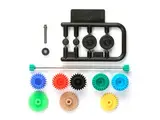
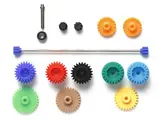
Against that, the double-shaft chassis are the simplest to assemble and the hardest to get wrong, and MA is the chassis most often recommended to beginners. Both routes are well trodden. Decide which side you care about more.
For the motors in each line and how to pick one, read Choosing a motor.
The second question: which kind of track
- Flat tracks with no jumps or slopes reward straight-line and cornering speed. A light car has the edge, and rear-motor chassis are the usual choice.
- 3D tracks with jumps, slopes and undulations are what most tracks are today. A car that flies too far leaves the track and has to land steady, so a chassis with its weight forward is calmer, and brakes and mass dampers go on whichever chassis you run.
- Not sure yet: pick the chassis with the most parts and the most write-ups, and adjust to the track later.
The eight chassis, one by one
Each entry links to its chassis page, which holds the specs, the bare runner's stock parts and every kit built on it, followed by a few kits on sale now. Choosing a kit opens the builder on it.
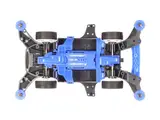 MA Chassisma
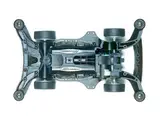 AR Chassisar
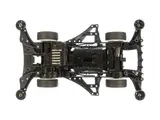 FM-A Chassisfm-a
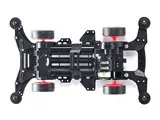 VZ Chassisvz
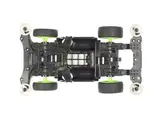 MS Chassisms
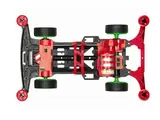 Super-II Chassissuper-2
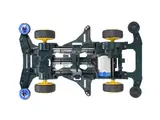 VS Chassisvs
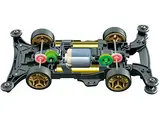 ME Chassisme
Tamiya's published weights are for the kit as boxed, and each chassis was weighed with different tires, some on small low-profile tires and some on large ones. Treat them as a rough guide rather than a ranking.
MA: the usual first choice
Double shaft, motor in the middle. A one-piece frame with high rigidity, six rollers out of the box and only 2.2 mm of ground clearance, so the centre of gravity is low. It has the most current kits of any chassis and the most write-ups, so an answer to any problem is easy to find. Its drawbacks are that it is the heaviest of the eight, and that its parts and gear ratios are confined to the double-shaft line.
For: a first build, and anyone who wants the fewest wrong turns.
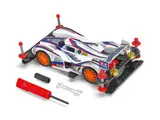 MINI 4WD STARTER PACK MA POWER SPEC (BLAST ARROW)18647
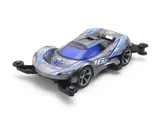 STIER (MA CHASSIS)18660
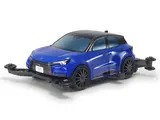 LEXUS LBX MORIZO RR (MA CHASSIS)18661
AR: the single-shaft chassis that is easiest to maintain
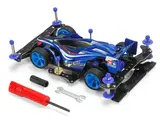
Single shaft, motor at the rear. Tamiya's first chassis with six rollers as standard, with the batteries mounted low and a closed underside, so the motor and batteries come out without lifting the body. Its 82 mm wheelbase is a little longer than most, which steadies it on straights, and 5 mm of clearance keeps it off the track surface. Like MA, it is on the heavy side.
For: anyone who wants to learn by taking things apart, and anyone who wants single-shaft motors and the setting gear set.
FM-A: the steady choice for 3D tracks
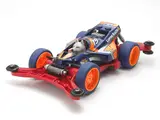
Single shaft, motor at the front. The forward weight makes landings calmer on tracks with many jumps and slopes, and a skid bar under the nose covers its 2.5 mm of clearance. Many racers run it in Stock Class / B-MAX, one reason being that its gears are easy to reach, swap and maintain. The propeller shaft has to be fitted accurately for it to run smoothly, so assembly asks more care than MA.
For: anyone who mostly runs 3D tracks.
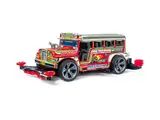
VZ: the lightest in production
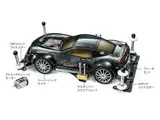
Single shaft, motor at the rear. The lightest of the eight and compact with it. The front bumper and rear roller stay are separate pieces, so a crash breaks one part rather than the frame; think of it as the successor to VS. It has fewer kits, and most of them are limited editions.
For: anyone chasing speed on flat tracks who is happy to buy the parts separately.
MS: the base of the Open-class builds
Double shaft, motor in the middle. The frame splits into nose, centre and tail, with 4 mm of clearance. It is the basis of the "MS flex" suspension conversion common in Open class, but that conversion cuts the frame, which Stock Class and B-MAX do not allow. At the Tokyo round of Japan Cup 2026, the Open class winners on 11 and 12 July both ran an MS chassis (Tamiya's event reports, in Japanese: 11 July, 12 July).
For: anyone who has already decided on Open class and wants to follow the experienced builders. A beginner can run it in Stock Class as it is; its strengths only show once modified.
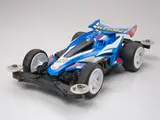
Super-II: the chassis under the classic cars
Single shaft, motor at the rear. The improved Super-1, with 5.3 mm of clearance and a wide choice of upgrade parts. Tamiya's yearly zodiac editions and many retro cars use it.
For: anyone who wants a particular body that happens to sit on this chassis.
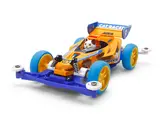
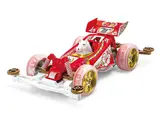
VS: the light old one
Single shaft, motor at the rear. A classic chassis with a short wheelbase and a light frame, sold today mainly as re-releases. There is room to modify it, but it is less rigid than the newer chassis.
For: anyone who likes the re-released cars, or already owns one. There is no need to seek it out for a first car.
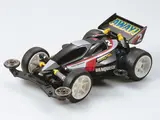
ME: the newest, with the fewest parts
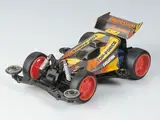
Double shaft, motor in the middle. Eligible for sanctioned races since January 2026, lighter than MA, with a frame that balances rigidity and flex and bumpers that are separate pieces front and rear. Racers were running it in Stock Class / B-MAX soon after release and report that it runs smoothly with little adjustment; some also report a front bumper that breaks easily, and how well it lasts is not yet known. Only two kits exist so far, and Tamiya's list of compatible parts is far shorter than for any other chassis.
For: anyone who wants to try what is new. It can be a first chassis if you accept the smaller choice of kits and parts for now; MA is the safer pick.
Quick picks
- A first car, no fuss: MA.
- Single-shaft motors and slower gear ratios: AR.
- A 3D track with jumps: FM-A, then MA.
- A flat track and top speed: VZ.
- Planning an Open-class build later: MS.
- Set on one particular body: find which chassis it uses, then read that section above.
Further reading
- Mini 4WD Chassis & Compatible Parts Catalogs (Tamiya, English): Tamiya's own rundown of each chassis by motor layout, with the cars and parts that fit it.
- シャーシセレクトガイド (Tamiya Japan, Japanese): the same guide in the original.
Pick a chassis or a kit in the builder and you can try parts on it one at a time, and see which ones fit.