Choosing a motor: the fifteen upgrade motors compared
The motor that comes in a kit is only there to make the car run. Swapping it for an upgrade motor is the cheapest change with the biggest effect. Tamiya sells fifteen upgrade motors today, and three questions in order pick one: which shaft your chassis takes, which motors your race class allows, and whether your track wants speed or torque.
The first question: single shaft or double
The chassis decides this one for you:
- Double shaft (PRO): the MA, MS and ME chassis. The motor has a shaft out of each end, and its name ends in "PRO".
- Single shaft: AR, FM-A, VZ, Super-II, VS and every other chassis.
The two kinds do not interchange. If you have not settled on a chassis yet, read Choosing a chassis first.
The second question: which class you race in
Tamiya's sanctioned races limit the motor by class:
- Open and Stock Class / B-MAX: the Tune series and most of the Dash series are allowed.
- Junior and Trial (Trial is the entry class for high-school age and up): the kit motor and the Tune series only.
- Ultra-Dash and Plasma-Dash: not allowed in any sanctioned race.
Those are Tamiya's own rules. A shop's race can set different ones, so read the organiser's rules before you enter.
Reading speed and torque
Every motor's packet prints two numbers:
- Speed (rpm): how many turns a minute. More of it means a higher top speed on a straight.
- Torque (mN·m): how hard the motor pushes. More of it means a quicker start, a stronger climb and faster recovery out of a corner.
Three things to keep in mind when you read them:
- They trade off. Within a series the faster motor usually has less torque, and no motor leads on both.
- They are ranges, not a ranking. Two motors of the same model do not perform alike, and when two models' ranges overlap, only running them says which is faster.
- The gear ratio counts as much. A motor with torque to spare can pull a fast ratio such as 3.5:1. A low-torque motor on a fast ratio bogs down on climbs and out of corners, and one step slower often gives a better lap.
All fifteen at a glance
Single-shaft motors, slowest first:
| Motor | Speed (rpm) | Torque (mN·m) | Race classes |
|---|---|---|---|
| TORQUE-TUNED 2 MOTOR | 12300–14700 | 1.6–2 | All classes |
| ATOMIC-TUNED 2 MOTOR | 12700–14900 | 1.5–1.8 | All classes |
| REV-TUNED 2 MOTOR | 13400–15200 | 1.2–1.5 | All classes |
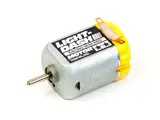
| LIGHT-DASH MOTOR | 14600–17800 | 1.3–1.9 | All but Junior |
| HYPER-DASH 3 MOTOR | 17200–21200 | 1.4–1.9 | All but Junior |
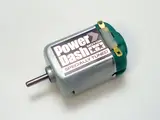
| POWER-DASH MOTOR | 19900–23600 | 1.5–2 | All but Junior |
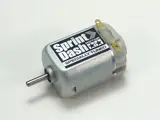
| SPRINT-DASH MOTOR | 20700–27200 | 1.3–1.8 | All but Junior |
| MINI 4WD ULTRA-DASH MOTOR | 24000–27500 | 1.4–1.9 | Not race-legal |
| PLASMA-DASH MOTOR | 25000–28000 | 1.4–1.9 | Not race-legal |
Double-shaft (PRO) motors, slowest first:
| Motor | Speed (rpm) | Torque (mN·m) | Race classes |
|---|---|---|---|
| TORQUE-TUNED 2 MOTOR PRO | 12200–14400 | 1.7–2.1 | All classes |
| ATOMIC-TUNED 2 MOTOR PRO | 12300–14500 | 1.6–1.8 | All classes |
| REV-TUNED 2 MOTOR PRO | 13200–14900 | 1.2–1.5 | All classes |
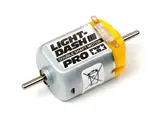
| LIGHT-DASH MOTOR PRO | 14600–17800 | 1.3–1.9 | All but Junior |
| HYPER-DASH MOTOR PRO | 17200–21200 | 1.4–1.9 | All but Junior |
| MACH-DASH MOTOR PRO | 20000–24500 | 1.3–1.8 | All but Junior |
The Tune series: a first upgrade
A Tune motor is one step up from the kit motor. It is light on batteries, keeps the car easy to control, and is legal in every class. Each of the three Starter Packs includes one, and between them they cover the three characters.
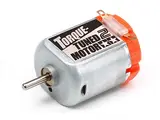
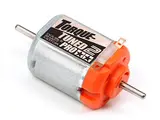
Torque-Tuned 2: torque
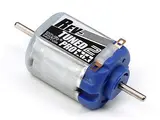
The most torque in the Tune series, so the strongest on a climb and when picking up speed after a landing. It suits a 3D track with many slopes and jumps. The MA Starter Pack includes its PRO version.
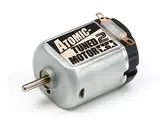
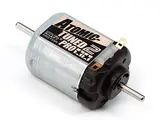
Atomic-Tuned 2: balanced
Middling speed and middling torque, which copes with any track. If you do not yet know what kind of track you will run on, this is the hardest one to get wrong. The FM-A Starter Pack includes the single-shaft version.
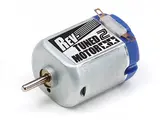
Rev-Tuned 2: speed
The highest speed and the least torque in the Tune series. It suits a flat track with long straights and loses pace on a 3D track with many slopes. The AR Starter Pack includes the single-shaft version.
The Dash series: what races are run on
A Dash motor is much faster than a Tune motor. It is legal in Open and in Stock Class / B-MAX, but not in Junior or Trial. With the extra speed the car leaves the track more easily at corners and jumps, so the brakes, mass dampers and rollers all need setting again when you fit one. It also draws more current than a Tune motor, so the state of the batteries shows more in the lap time.
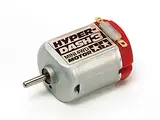
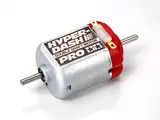
Hyper-Dash: the one most racers use
The single-shaft Hyper-Dash 3 and the double-shaft Hyper-Dash PRO are the motors seen most on 3D tracks today, and most racers' first Dash motor. Speed is well above the Tune series and torque is no lower, which balances pace against control. Tamiya's yearly Japan Cup edition is this motor too, with the same performance as the regular one.
Light-Dash: between the two series
Its speed sits between the Tune series and Hyper-Dash. If the car keeps leaving the track on a Hyper-Dash, this is the step back.
Power-Dash and Sprint-Dash: single shaft only
Both are faster than Hyper-Dash 3, in opposite directions. Power-Dash has the most torque of the Dash series, for a heavy car on a track with many slopes that keeps asking it to pick up speed again. Sprint-Dash has the highest speed of any race-legal single-shaft motor and the least torque, for a fast track with long straights. Both draw more current than Hyper-Dash 3 and make the car harder to control, so try them once you are at home on Hyper-Dash 3.
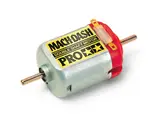
Mach-Dash PRO: double shaft only
The fastest race-legal double-shaft motor, the counterpart of Sprint-Dash and Power-Dash on the single-shaft side. It is clearly faster than Hyper-Dash PRO on a straight, but the car jumps further, lands less steadily, and needs more brake.
Why the fastest is not always the best
Most tracks today are 3D tracks with jumps and slopes. On one of those a car that leaves the track once has lost, so the contest is not top speed but the pace it can hold lap after lap. The faster the motor, the further the car jumps and the worse it lands, and the more brake it takes to pull the speed back, so the lap may be no quicker. That is why many racers stay on Hyper-Dash on a 3D track and leave the faster Mach-Dash PRO or Sprint-Dash in the box. The Tokyo round of Japan Cup 2026 is an example: the Open class winners on 11 and 12 July both ran a Hyper-Dash PRO on a 4:1 gear ratio, the slowest a double-shaft chassis takes (Tamiya's event reports, in Japanese: 11 July, 12 July).
On a flat track with no jumps it is the other way round: top speed decides the race, and a high-speed motor on a fast gear ratio earns its place.
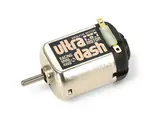
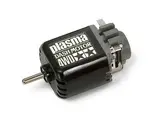
Ultra-Dash and Plasma-Dash: not for sanctioned races
These are Tamiya's two fastest motors. Shops hang them beside the others, and beginners buy them by mistake. They are not allowed in any sanctioned race, they draw more than twice the current of a Tune motor, and an ordinary 3D-track setup will struggle to keep the car on the track. Unless you only run straights on a flat track at home, leave them. In the builder, fitting either one with a race class chosen shows a rule warning.
Limited and anniversary editions
Tamiya releases a Japan Cup edition each year, and anniversary editions now and then. Only the label and colours differ: performance and class legality are the same as the regular motor of the same name, so choose on price and taste. The motor category page lists them all.
Running in a new motor
A new motor needs some running before its performance settles, which racers call breaking in. The simplest way is to fit it and run a few sets of batteries through the car before you start tuning. Sanctioned races do not allow a motor to be opened or modified, and break-in machines and speed checkers may not be brought into the venue.
Quick picks
- First motor swap, track unknown: Atomic-Tuned 2.
- 3D track, just starting to upgrade: Torque-Tuned 2.
- Flat track: Rev-Tuned 2.
- Racing in Junior or Trial: one of those three is the whole choice.
- Brakes and mass dampers already fitted, and you want more pace: Hyper-Dash 3 or Hyper-Dash PRO.
- The car keeps leaving the track on a Hyper-Dash: adjust the brakes first, and if that is not enough, fit a Light-Dash.
- Top speed on a flat track: Sprint-Dash on a single shaft, Mach-Dash PRO on a double.
Further reading
- Mini 4WD Setup Guide (Tamiya, English): the key setup points, motor and gear ratio among them.
- ミニ四駆公認競技会規則 (Tamiya Japan, in Japanese): the full list of motors allowed in sanctioned races.
Fit a motor to your car in the builder and choose a race class, and it will tell you whether the motor is allowed.