Getting started: begin with a Starter Pack
For a first Mini 4WD, we suggest one of Tamiya's Starter Packs. Each box holds a complete car, an upgraded motor, and the parts most tracks ask for: reinforcing plates, brakes, mass dampers and super-hard tires. The jumps and the corners are where a new car usually fails on its first day at a track, and these parts are there for exactly that. Buying a standard kit and adding them one by one costs more.
There are three, one for each of the MA, AR and FM-A chassis:
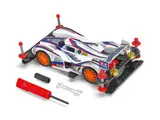 MINI 4WD STARTER PACK MA POWER SPEC (BLAST ARROW)18647
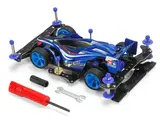 MINI 4WD STARTER PACK AR SPEED SPEC (AERO AVANTE)18706
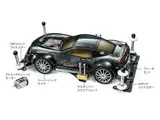 MINI 4WD STARTER PACK FM-A BALANCED SPEC (ROWDY BULL)18710
Pick any of them to start the builder with it: you can see its chassis and every part in it, and try swapping them one at a time.
Not sure? Take the MA Power Spec
The MA Power Spec (Blast Arrow) is the first car most racers suggest to a beginner.
- The MA chassis uses a double-shaft motor in the middle of the car, driving the front and rear wheels directly. There is no propeller shaft to set up, so there is little to get wrong.
- It comes with a Torque-Tuned 2 PRO motor and a 3.7:1 gear ratio, so it holds its speed up slopes and out of corners.
- It adds front and rear FRP plates, brakes, a front under guard, mass dampers, super-hard tires and a Phillips screwdriver.
- MA has the most setup advice written about it, so an answer is easy to find.
- The catch: it is the heaviest of the three, and the slowest on a long straight.
For straight-line speed: the AR Speed Spec
AR Speed Spec (Aero Avante)
- The AR chassis carries a single-shaft motor at the rear. It sits low and is easy to take apart, which suits someone who wants to learn what each part does by changing it.
- It comes with a Rev-Tuned 2 motor and a 3.5:1 gear ratio, the quickest of the three to accelerate on a straight.
- It adds front and rear FRP plates, side mass dampers, a brake, super-hard tires, and a screwdriver and wrench.
- The catch: the Rev-Tuned 2 has less torque, so a track with many slopes and obstacles can stall it.
For a strong front end: the FM-A Balanced Spec
FM-A Balanced Spec (Rowdy Bull)
- The FM-A chassis carries a single-shaft motor at the front, and stays steady over jumps and on tracks that climb and drop.
- It comes with an Atomic-Tuned 2 motor, balanced between speed and torque, and a 3.5:1 gear ratio.
- It adds front and rear FRP plates, a brake, square mass dampers and super-hard tires.
- The catch: the propeller shaft has to sit just right for the car to run smoothly, so it takes more care to build than the MA. Owners report no screwdriver in the box, so have one ready.
Already have a standard kit: add a Basic Tune-Up Parts Set
If you already own a standard kit, or the car you like has no Starter Pack, Tamiya's Basic Tune-Up Parts Sets put the first upgrades most cars get in one box: front and rear plates, front and rear rollers and mass dampers. The MA, AR, FM-A and VZ each have their own set, and one more fits the Super-II, VS and a few others, so check that the set suits your chassis before you buy:
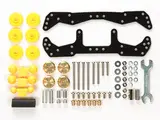 BASIC TUNE-UP PARTS SET for MA CHASSIS15476
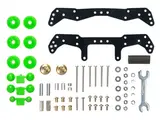 BASIC TUNE-UP PARTS SET for AR CHASSIS15450
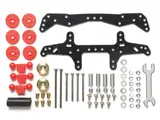 BASIC TUNE-UP PARTS SET for FM-A CHASSIS15514
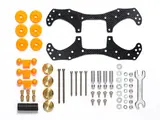 BASIC TUNE-UP PARTS SET for VZ CHASSIS15526
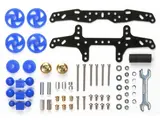 MINI 4WD BASIC TUNE-UP SET15435
Press “Add the whole set” to fit the whole box onto the car in the builder and see where each piece goes.
What else you need
- Two AA batteries, which are not in the box. Alkaline cells are fine to start; if you race often, rechargeable NiMH cells and a charger pay for themselves.
- A Phillips screwdriver: included with the MA and AR packs; bring one for the FM-A.
- No glue: all three snap together.
Once it runs
Run a full lap on the setup from the box first, then change one part at a time and see which change actually helps. Change several at once and you cannot tell which one did it. Go easy on the brakes at first, too: too much brake and the car crawls.
When you want more pace, the usual next step is the motor. All three Starter Packs come with a Tune motor, and Choosing a motor says which one to move to and why the fastest is the wrong one to buy first.
In the builder you can try a part before you buy it, and see where it goes and whether it fits your chassis.